

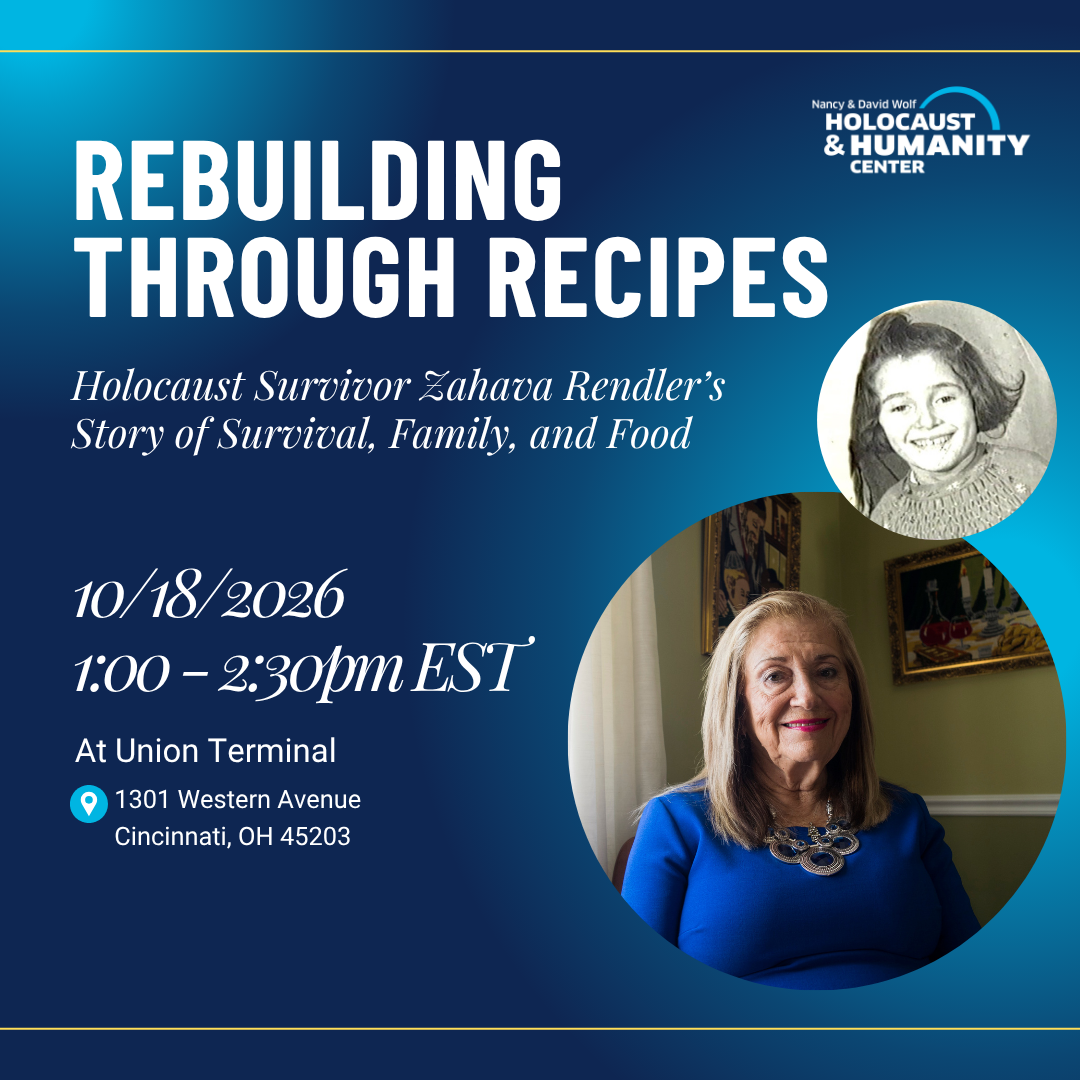
Holocaust Survivor Zahava Rendler’s Story of Survival, Family, and Food
Join the Nancy & David Wolf Holocaust & Humanity Center and Cincinnati Museum Center in the crEATe Culinary Studio featuring the Kroger Food Lab for an intimate program exploring the role of food, family, and memory in the lives of Holocaust survivors.
As part of our culinary series, Holocaust survivor Zahava Rendler will share her remarkable story of resilience and rebuilding.
Zahava was born Golda Feuerberg in Stryi, Poland, just before the Nazi invasion. A Polish neighbor named Stachek hid her, her parents Gretel and Mendel, and about 30 other people in an underground bunker, bringing them food once a week. Zahava was only a baby, and the bunker had to remain quiet, so the adults would give Zahava sleeping pills to muffle her cries.
After about a year in hiding, Zahava’s parents entrusted her to a Polish woman involved in the Resistance, who placed her with a Polish Catholic family in Lvov. When it became too dangerous for the family to continue hiding her, Zahava was sent to a nearby convent, where she lived under the false identity “Olga Pachulchak.”
After the war, Zahava was reunited with her parents, who had also survived in hiding. The family later attempted to settle in Palestine but was detained by the British in a displaced persons camp on the island of Cyprus. Eventually, they were permitted to settle in Haifa, where Golda took the Hebrew name Zahava, meaning “gold.” She came to Cincinnati in 1963.
During this special program, Zahava will reflect on her family’s story and the ways food can carry memories, traditions, and connections across generations. While preparing recipes like a traditional poppy seed cake, guests will explore how family recipes can preserve the stories and traditions of those who came before us.
This culinary series is generously made possible by the generosity of Barbara Kellar.